
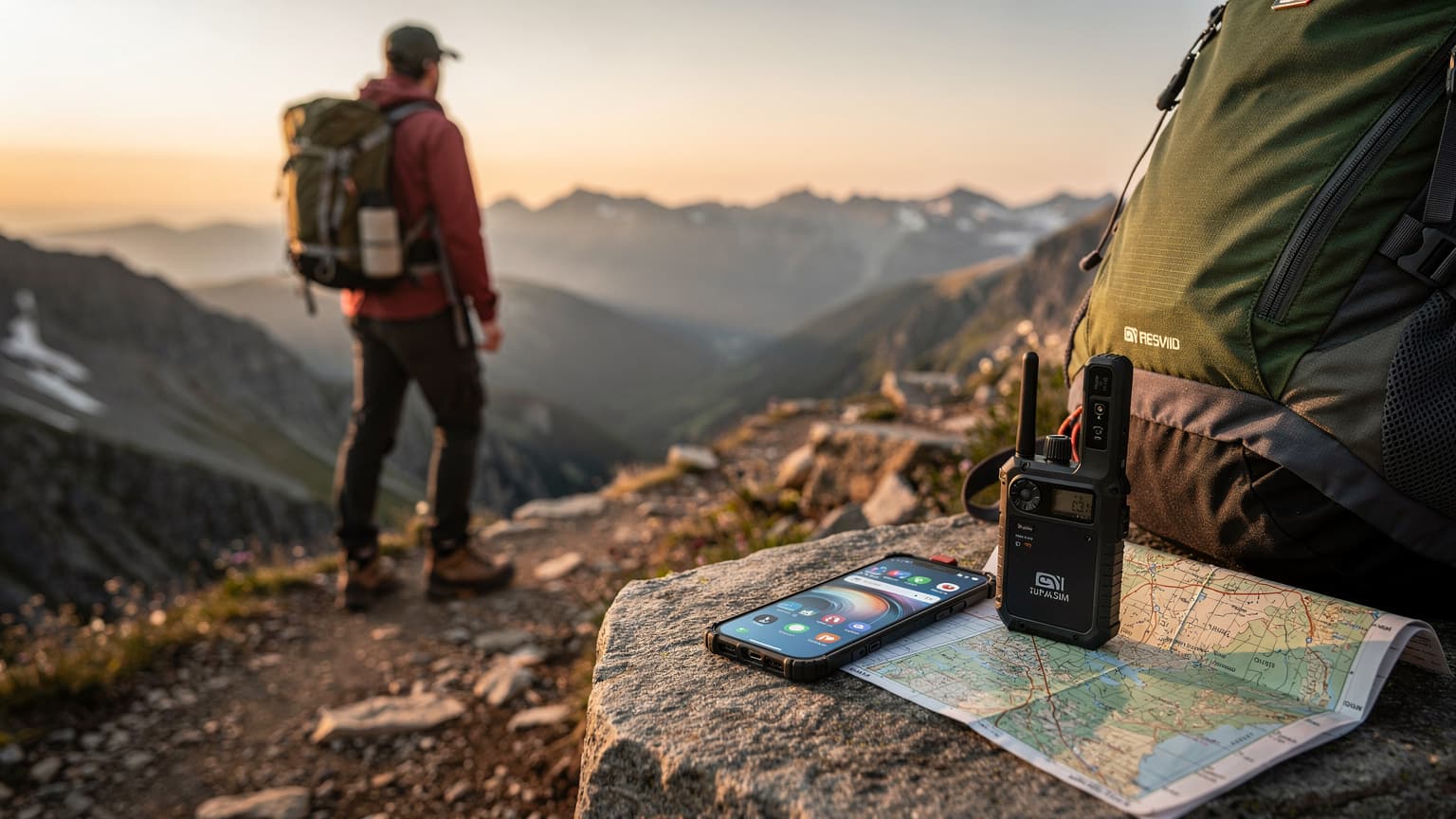
eSIM for the Edge of the Wilderness
Let's be clear, an eSIM isn't magic. It's still reliant on cellular infrastructure. But for those 'edge of the wilderness' scenarios, where you're just beyond reliable city coverage but not yet in the true boonies, it's a solid win. Think of it as your primary communication tool when a signal is merely weak, not absent. I've used an eSIM across the Andes, specifically in the smaller towns outside Huaraz, Peru, where a local SIM card (from Claro or Movistar) would have meant hunting down a tiny shop, dealing with registration, and probably getting ripped off on data bundles. With an eSIM, I had data minutes after landing at Lima's Jorge Chávez International Airport, which meant I could instantly book my long-distance bus ticket to Huaraz and confirm my hostel in the José Olaya neighborhood, all before even leaving the terminal. This is where the flexibility of something like a Peru's Inca Trail 2026: eSIM for High-Altitude Trekking & Safety plan really shines. You're connected, quickly, without the hassle of a physical SIM.
The 'Good Enough' Scenario: When eSIM Wins
An eSIM excels in areas with patchy but existing cellular coverage. This isn't about deep backcountry; it's about the fringe. I remember being in a small guesthouse in Phong Nha, Vietnam, trying to coordinate a motorbike rental for exploring the national park. The guesthouse Wi-Fi was, to put it mildly, 'optimistic'. My eSIM, however, on the local Viettel network, pulled down enough signal to use Grab and translate some complex Vietnamese instructions. It wasn't blazing fast, but it was functional, allowing me to handle logistics that would have been impossible otherwise. For most travelers, this is the realistic 'wilderness' they encounter: rural areas, national parks with visitor centers, or small towns skirting major trekking routes. In these spots, an eSIM provides the data for mapping apps, emergency calls (if a tower is within range), and keeping in touch with home, without the bulk of a physical SIM or the setup of a local carrier.
Limitations of eSIM in True Off-Grid
Here's the brutal truth: if there's no cell tower, an eSIM is a paperweight for communication. It doesn't matter how many gigabytes you have or how robust your plan is. This limitation is critical. On the Annapurna Circuit in Nepal, once you're a day or two past Besisahar, cellular signal becomes a myth. Same goes for large swathes of Patagonia's Carretera Austral, or the vast interior of Iceland. If your adventure takes you truly beyond the reach of any cellular network, even the most expansive global eSIM will not help you call for help. This is a hard line, and it's where the conversation shifts dramatically toward dedicated satellite communication. (And no, those 'Wi-Fi calling' features won't work without Wi-Fi, which itself needs an internet connection.)
When Cellular Dies, The Satellite Messenger Lives
This is where the satellite messenger earns its keep. When you're days from a road, with no human in sight for miles, and you take a bad fall, your phone, with or without an eSIM, is essentially useless for contacting anyone. A satellite messenger, however, can send an SOS. I've carried a Garmin inReach Mini 2 for years, through the Dolomites and the Sierra Nevada, and while I hope to never hit that red button, the peace of mind it offers is invaluable. These devices tap into global satellite networks, like Iridium or Globalstar, which cover virtually the entire planet, pole to pole. That means a signal, almost always.
How Satellite Messengers Work
Satellite messengers are purpose-built for one thing: communication when nothing else works. They typically offer two-way text messaging, GPS tracking, and, most importantly, an SOS button that connects you directly to a 24/7 emergency response center. The center, usually GEOS or a similar service, will then coordinate with local search and rescue teams based on your precise GPS coordinates. It's not a phone call, but it's effective. (And for the record, I always let my emergency contacts know my exact route and expected check-in times, even with a sat device.)
Using a satellite messenger usually involves a clear line of sight to the sky. Dense tree cover or deep canyons can obstruct the signal, but typically, a few minutes of patience or moving to a clearer spot will resolve it. The key difference is that they don't rely on terrestrial infrastructure, which makes them the only true 'off-grid' communication solution.
Types of Satellite Devices
There are a few major players in the satellite messenger space, each with slightly different features and pricing models:
- Garmin inReach Series: These are probably the most popular, offering two-way messaging, SOS, weather forecasts, and GPS navigation. The inReach Mini is compact and robust.
- Zoleo Satellite Communicator: A more recent contender, the Zoleo seamlessly switches between cellular, Wi-Fi, and satellite messaging, which can be a cost-saver in areas with intermittent cell service.
- Spot Devices: Spot has been around for a long time, primarily offering one-way check-in messages and SOS functions. Some newer models have added two-way messaging.
- Dedicated Satellite Phones: Think Iridium or Thuraya. These are full-on phones that make voice calls via satellite. They are significantly more expensive to buy and operate, and generally overkill unless you're truly leading expeditions into the most remote corners of the planet for extended periods.
The Real Cost, Beyond the Hardware
Neither an eSIM nor a satellite messenger is a one-time purchase. There are ongoing costs, and they differ significantly. An eSIM might cost you $20 for 10GB over 30 days in Europe, a manageable expense. A satellite messenger requires a device purchase (typically $200-500) and then a monthly or annual subscription plan. These plans can range from $15 to $60+ per month, depending on the number of messages, tracking intervals, and included SOS services. If you only trek once a year for a week, that annual fee can feel steep. If you're out there for months, it's just part of the budget.
eSIM Cost Models
eSIMs are usually prepaid, data-centric plans. You buy a package, use it up, and top up or buy another. Some providers offer regional plans, like an Asia-20 eSIM for Seamless 2026 Travels, which covers multiple countries, simplifying things immensely. These are ideal for digital nomads who bounce from city to city, hitting cafes like The Commons in Bangkok's Thonglor district (great Wi-Fi, by the way) or Outpost in Canggu, Bali. I’ve found that a typical monthly data plan for an eSIM costs around $25-40 for 20-30GB, which is more than enough for everyday browsing, social media, and video calls. For a long-stay nomad, this is a fraction of what you'd pay for a local post-paid plan, and without the hassle of local ID registration, which some countries like India (for Aadhaar) or Brazil (for banking apps) demand.
Satellite Messenger Subscription Fees
Satellite messenger subscriptions are structured differently. You often pay a base fee for emergency services and a certain number of messages, with additional charges for exceeding those limits. Many offer seasonal plans where you can suspend service during off-peak months, which is a smart move if you're not always in the backcountry. Always check the fine print for activation fees, cancellation policies, and the cost of additional messages. It's not uncommon for a weekend warrior to pay $200 a year for the peace of mind, even if they only use it to send a few 'I'm okay' messages.
| Feature | eSIM (Smartphone) | Satellite Messenger |
|---|---|---|
| Primary Function | Standard Calls, Data, SMS | Emergency SOS, Two-Way Text, GPS Tracking |
| Network Reliance | Terrestrial Cellular Towers (4G/5G) | Global Satellite Constellations (Iridium, Globalstar) |
| Coverage Area | Where cellular networks exist (cities, towns, some rural) | Nearly global, including remote and off-grid areas |
| Cost (Device) | Smartphone cost (existing device) | $200 - $500+ (dedicated device) |
| Cost (Subscription) | $5 - $50/month (data plans) | $15 - $60+/month (SOS + messages) |
| Battery Life | Hours to 1-2 days (smartphone use) | Days to weeks (dedicated, low power) |
| Weather Dependency | Minimal, but signal can be affected | Can be affected by heavy cloud cover, dense tree canopy |
Power Management and Device Dependency
This is a big one. Your smartphone, whether running an eSIM or a physical SIM, is a power hungry beast. GPS, screen brightness, app usage, searching for signal, all drain the battery rapidly. In a true emergency, you want a device that sips power, not gulps it. My phone usually lasts a day and a half with moderate use, but if I'm navigating with GPS all day, it's dead by dinner. A satellite messenger, by contrast, is designed for extreme battery efficiency. My inReach Mini will go for days, sometimes weeks, on a single charge if I'm just sending occasional check-in messages. This difference is not trivial; it can be life-saving.
Smartphone Battery Drains
Consider a typical scenario: you're on a multi-day trek in the wilderness. You use your phone for photos, checking a GPX track, maybe a quick message when you hit a rare pocket of signal. Before you know it, you're at 20%. If an emergency arises then, you're in a tough spot. External power banks are essential, but they add weight and are also finite. The phone is a generalist tool, not a specialist for survival communication. This is why I always have a separate, fully charged power bank, and often a smaller 'emergency-only' one stashed deep in my pack. (It's saved me more times than I can count when I needed to check a booking in a place like Ubud, where Wi-Fi can be surprisingly spotty even in the middle of town.)
Satellite Messenger Longevity
Satellite messengers are built to last. They have minimal screens, limited processing power, and their radios are designed for intermittent bursts of activity, not constant data streaming. Many also use standard AA or AAA batteries, or have internal batteries that last for hundreds of hours in standby mode. This extended battery life is a critical safety feature. You don't want to be rationing battery when you're injured and need to send repeated SOS messages. This robustness is part of their appeal for serious backcountry enthusiasts. I've had my inReach Mini sit in my pack for a month, pull it out, and it's still at 70% charge.
Situational Awareness: Choosing the Right Tool
The choice isn't necessarily one or the other; it's about understanding your environment and your needs. Are you doing day hikes from a well-serviced town, or are you embarking on a month-long expedition into uncharted territory? The answer will dictate your communication strategy.
Day Trips and Accessible Trails
For most casual outdoor enthusiasts, an eSIM is probably sufficient. If you're hiking a popular trail in a national park with known cellular coverage (even if spotty), or doing day trips from a base camp where you have Wi-Fi, your phone with an active eSIM plan, like a USA eSIM, will serve you well. You can download offline maps, check weather forecasts, and make calls if needed. Just ensure you have a good power bank. I often use my phone for navigation on shorter hikes around places like the Cinque Terre in Italy, where there are plenty of small towns with cell service, but always download the maps beforehand, just in case.
Extended Backcountry Expeditions
This is where the satellite messenger becomes non-negotiable. If you're going into areas without any predicted cellular coverage for days or weeks, particularly where search and rescue might be difficult, a satellite messenger is a must-have. Think remote alpine climbs, multi-week river expeditions, or deep jungle treks. Your life, or the lives of your companions, could depend on it. This isn't just for emergencies, either. Being able to send a 'we're fine' message to loved ones can prevent unnecessary worry and even false alarms, which can tax rescue resources. I've known people who got stuck in a storm on a multi-day trek in the Scottish Highlands, and their simple 'delayed but safe' message via satellite saved their families a lot of stress.
The Hybrid Approach: Best of Both Worlds
For many serious adventurers, the ideal setup involves both. An eSIM provides convenience and connectivity in populated areas and the fringes of the wilderness, while a satellite messenger acts as the ultimate safety net for true emergencies. This isn't overkill; it's intelligent risk management.
Why Carry Both?
Think of it this way: your eSIM is your everyday driver, your satellite messenger is your emergency spare tire. You use your phone for maps, photos, and communication when there's signal. If that signal disappears, or if a critical emergency arises, you switch to the dedicated device. This dual approach saves money, as you're not constantly paying for expensive satellite data for routine communication, and it ensures you have the right tool for the job. I always carry both, especially when I'm out for weeks at a time, for example, exploring the less trodden paths in Hokkaido, Japan. I use my Taiwan Lantern Festival 2027: Don't Miss a Photo, Connect Smart with eSIM plan for all my normal connectivity needs in towns and cities, but the satellite device is there for the deep backcountry.
Integrating Your Devices
Many satellite messengers integrate with your smartphone via Bluetooth, allowing you to use your phone's keyboard for easier typing of messages, or to view maps with your location superimposed. This makes the satellite messenger more user-friendly when you do need it. Remember to keep both devices charged, and ensure you understand how to use your satellite messenger before you leave. Practice sending test messages; don't wait for an emergency to learn the interface.
- Test your satellite messenger: Before every trip, send a test message to ensure it's working and your subscription is active.
- Download offline maps: For both your phone (Google Maps, Gaia GPS) and your satellite messenger (if it has mapping capabilities).
- Charge everything: Phone, satellite messenger, power banks. Ensure all are topped up.
- Inform your emergency contacts: Share your itinerary, expected check-in times, and who to contact if you miss a check-in.
- Carry physical navigation: A map and compass are still vital backups, especially if electronics fail.
| Scenario | Best Option | Reasoning |
|---|---|---|
| Urban exploration, city travel | eSIM | Ubiquitous cellular coverage, data for navigation, communication, apps. |
| Day hikes in popular national parks | eSIM (+ power bank) | Likely intermittent cellular, need for mapping, emergency calls if signal exists. |
| Multi-day trek, near civilization | eSIM + Power Bank + Local contact/info | Some cellular expected, but power management critical, local resources accessible. |
| Remote backcountry, no cellular | Satellite Messenger (dedicated) | Essential for global SOS, two-way messaging for safety when cellular is non-existent. |
| Expedition-grade wilderness travel | eSIM (for approach/return) + Satellite Phone/Messenger (primary) | Comprehensive safety and communication in extreme, prolonged off-grid situations. |
Local SIM Card vs. eSIM for Wilderness Travel
When you're dealing with the fringes of civilization, the choice between a physical local SIM and an eSIM might seem minor, but it's not. For a digital nomad hopping between countries, physical SIMs are a constant headache. I remember my time in Mexico City, specifically in the Roma Norte neighborhood, where I found an amazing coworking space called U-Co. My monthly rent for a decent apartment was about 15,000 MXN (around $850 USD at the time), and a local Telcel SIM was easy enough to get. However, for shorter stays, or when crossing multiple borders, dealing with different carriers, languages, and registration processes is a nightmare. This is where an eSIM simplifies everything, allowing you to activate a plan for a new region instantly, without swapping tiny pieces of plastic.
The Hassle Factor: Physical SIMs
Imagine landing in a new country, tired from a long flight, and your first task is to find a phone store, navigate language barriers, fill out paperwork, and possibly even deal with ID requirements (some countries, like Brazil, have strict rules for local SIM activation that can be a real pain if you don't have a local CPF ID). This is precious time wasted, time you could be using to get to your accommodation, grab some food, or simply rest. For someone on a tight schedule, or those who frequently move between regions, an eSIM completely bypasses this friction. If you're planning a trip that involves multiple destinations, say, a Caribbean Island Hopping 2026: One eSIM Plan for Every Beach? adventure, managing multiple physical SIMs quickly becomes unmanageable.
eSIM Convenience for Multi-Country Trips
This is where the eSIM truly shines for the modern traveler. You can purchase and activate a regional eSIM plan before you even leave home. This means you land with data, ready to navigate, order a ride-share, and contact your accommodation. This seamless transition is incredibly valuable, especially when you're moving between areas where cellular coverage might be intermittent. For instance, if you're traveling through Southeast Asia, one regional eSIM can cover you from the bustling streets of Kuala Lumpur to the quieter islands of Thailand, giving you continuous connectivity without needing to hunt down a SIM vendor at every border crossing. This convenience extends to emergency situations too, as you maintain a familiar phone number and data access, crucial for accessing local emergency services or information if a tower is available.
Pre-Departure Checklist for Off-Grid Connectivity
Before you head out, especially into areas where communication might be challenging, a thorough check is essential. This isn't just about packing your gear; it's about preparing your digital lifeline.
Essential Preparations
A little planning goes a long way. I've seen too many people assume their phone will 'just work' or that they'll 'figure it out' once they're out there. That's a recipe for stress, or worse. Here’s a basic rundown:
- Check coverage maps: Always consult the coverage maps for both your chosen eSIM provider and major local carriers for your destination. Don't just look at the country-level map; zoom in on your specific trek route.
- Download everything offline: Maps, guidebooks, emergency contacts, language translation packs. Assume you'll have zero internet when you need it most.
- Emergency contact cards: Physical cards with emergency numbers (local SAR, embassy, family) are a must. Your phone might die, or get lost.
- Learn basic phrases: Even if you have a translator app, knowing key phrases for 'help', 'injured', 'water', etc., can be crucial.
- Practice with your gear: Know how to use your satellite messenger, turn on SOS, and send custom messages before you're under duress.
Knowing Your Limits and Visa Restrictions
Finally, know not just the limits of your gear, but also the limits of your stay. Some countries have strict visa limitations for continuous stays, which impacts how long you can reasonably rely on an eSIM before needing to consider local residency. For example, the Schengen Area has a 90-day limit in any 180-day period. This affects not just your physical presence, but also how you manage your digital life. If you're pushing those boundaries, you might find yourself in a bind with things like bank verification apps that require a local SIM, or even just needing to renew an eSIM plan from a country you're technically no longer allowed to be in for an extended period. Always have a clear understanding of your visa status, especially if you're a long-term traveler. (And yes, I've had Brazilian banking apps lock me out because I didn't have a local SIM for verification, even after a month in a Rio co-working space like WeWork Flamengo.)
- Verify visa duration: Understand how long you can legally stay and if it affects continuous service or local app access.
- Check local SIM card requirements: Some apps, like banking or government services, may demand a local physical SIM for SMS verification, even if you primarily use an eSIM for data.
- Backup communication plan: Always have a secondary communication method, whether it's a second eSIM, a physical SIM, or a satellite device.
- Emergency fund: Ensure you have access to funds for unexpected events, including medical emergencies or extended stays.
Frequently Asked Questions
Can an eSIM replace a satellite messenger for wilderness emergencies?
No, an eSIM cannot replace a satellite messenger for true wilderness emergencies. An eSIM relies on terrestrial cellular networks, meaning it's useless where cell towers don't exist. A satellite messenger uses global satellite constellations, providing communication and SOS capabilities in truly off-grid areas, making it essential for remote safety.
Is an eSIM useful for any type of remote travel?
Yes, an eSIM is highly useful for remote travel where there is still intermittent or weak cellular coverage, such as rural areas, national parks with visitor centers, or small towns near trekking routes. It allows for convenient data access for navigation, communication, and emergency calls within cellular range, without the hassle of a physical SIM.
What are the main costs associated with a satellite messenger?
The main costs for a satellite messenger include the upfront device purchase, typically ranging from $200-$500+, and a recurring monthly or annual subscription fee. These plans can vary from $15 to $60+ per month, depending on the level of service, message limits, and SOS features. Some providers offer seasonal plans to reduce costs during off-peak times.
How long does a satellite messenger's battery typically last compared to a smartphone?
Satellite messengers are designed for extreme power efficiency, with batteries often lasting for days or even weeks on a single charge, especially in standby or with intermittent use. A smartphone, on the other hand, typically lasts hours to a day or two with moderate use, and drains much faster when actively searching for signal or using GPS, making external power banks essential.
Should I carry both an eSIM and a satellite messenger?
For serious adventurers, carrying both an eSIM and a satellite messenger is often the recommended hybrid approach. The eSIM provides convenient, everyday connectivity in areas with cellular service, while the satellite messenger acts as a critical safety net for true off-grid emergencies, ensuring you have the right communication tool for any situation.
Are there any apps that require a local physical SIM even if I have an eSIM?
Yes, some local apps, particularly banking, government, or ride-share applications in certain countries (like Brazilian banking apps or India's Aadhaar system), may require a local physical SIM card for SMS verification or account setup, even if you use an eSIM for data. This is an important consideration for long-term travelers or digital nomads.