

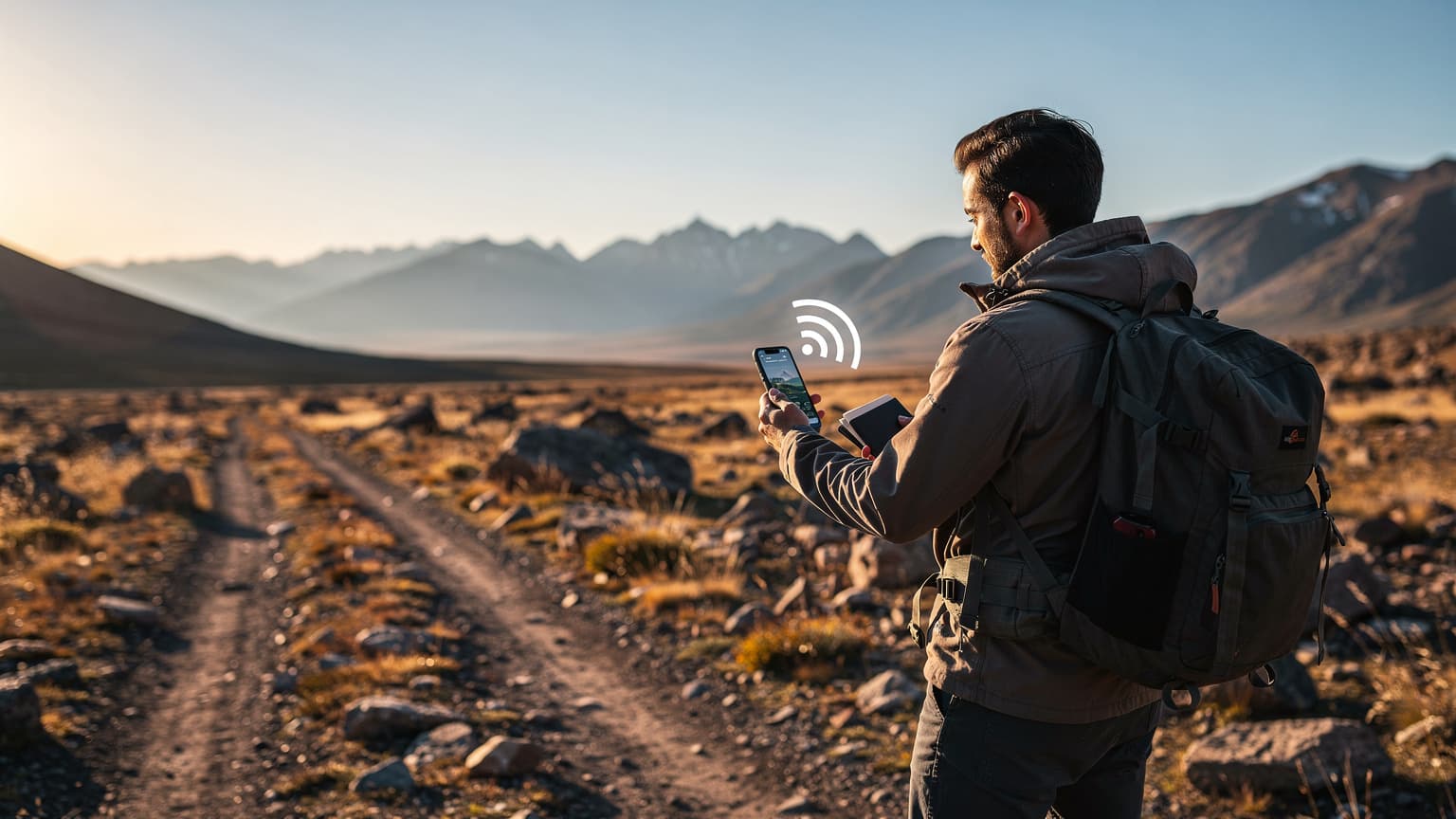
The Myth of Free Data in the Wild: Why 'Free' Rarely Means Off-Grid
I’ve spent the better part of fifteen years chasing signals in places where the nearest Wi-Fi router is a week’s hike away. From the remote reaches of Patagonia’s Cerro Castillo National Reserve to the high passes of Nepal’s Annapurna Circuit, connectivity has always been a gamble. And let me tell you, the phrase “free eSIM trial” often feels like another one of those gambles, especially when you’re really out there.
Most of these so-called free trials are built for the urban wanderer, someone looking to check Google Maps in Rome’s Trastevere district or hail a taxi through FreeNow in Berlin’s Kreuzberg. They offer a paltry 100MB, maybe 500MB, of data valid for a day or two. That’s enough to send a couple of WhatsApp messages or load a single webpage, but it’s utterly useless for actual off-grid reconnaissance, where checking topo maps, weather forecasts, or sending critical updates could be a matter of safety, not just convenience.
My phone, an iPhone 17, has been my constant companion, enduring drops, dust, and downpours. It’s also been the source of immense frustration when promises of connectivity evaporated the moment I left the paved road. The fundamental issue is that these trials are marketing tools, not robust solutions for places where cell towers are as rare as a quiet moment in Tokyo’s Shinjuku station during rush hour.
Understanding the Typical 'Free eSIM' Offer
When a provider dangles a “free trial,” what they usually mean is a sliver of data on a network that’s perfectly adequate in metropolitan areas. Think of it like being offered a free sip of water from a small bottle, when what you really need is a full hydration pack for a desert crossing. The data allowances are generally microscopic, often less than 500MB, and the validity periods are laughably short, sometimes as little as 24 hours.
Here’s what you usually get with a 'free' trial:
- Limited Data: Typically 100MB to 500MB. Enough for a quick check, not sustained use.
- Short Validity: Often 1 to 3 days, expiring quickly regardless of data usage.
- Urban Focus: Coverage is usually concentrated in major cities and tourist zones, not the remote wilderness.
- No Top-Up Option: You can’t usually add more data to a free trial, forcing a new purchase if you run out.
The Cost of Relying on Free Trials When It Matters
I learned this the hard way in the Ladakh region of India, specifically outside the main Leh town, near the monasteries of Hemis and Thiksey. I'd loaded up a 'free trial' that promised a taste of connectivity. The moment I ventured beyond the reach of the BSNL tower in Leh, the signal vanished. My 'free' data became entirely academic. What was supposed to be a quick check on a trail condition report turned into a 4-hour detour, relying on outdated paper maps and the kindness of strangers for directions to a small guesthouse in Stok Village. The actual cost wasn't monetary, but time, energy, and a significant amount of stress. It taught me that for anything beyond Instagramming your espresso in Paris, 'free' is often a false economy.
What Counts as a 'Free eSIM Trial' for Adventurers, Really?
For an off-grid adventurer, a 'free eSIM trial' isn't about getting something for nothing, it’s about testing the waters. It's about verifying coverage in a specific, potentially challenging, locale before committing to a larger data package. This means the trial needs to offer more than just a token amount of data in a city center. It needs to provide a genuine glimpse into the network's reach and stability in conditions that mimic your actual expedition plans.
True trials, for us, would ideally be:
- Sufficient Data: At least 1GB, enough to test basic navigation, communicate with a base camp, or download an emergency protocol.
- Extended Validity: A week or more, allowing for proper testing over varying terrain and conditions.
- Representative Coverage: A trial that explicitly states it uses the same network partners as their paid plans, and ideally covers specific regions known for sparse connectivity.
- Clear Upgrade Path: Seamless transition to a paid plan without needing to reinstall an eSIM profile.
These are rare, mind you. Most companies aren't in the business of handing out significant chunks of data for free. But knowing what to look for helps you sift through the marketing fluff.
Distinguishing a Marketing Gimmick from a Useful Test
A marketing gimmick will trumpet 'FREE DATA!' but bury the caveats in fine print. A useful test, however, will be transparent about its limitations and clear about its purpose. Look for providers that offer trials specifically for certain regions, or those that have strong partnerships with local carriers known for their wide rural coverage, like Telstra in Australia or MTN in South Africa. When I was planning a trip down the Garden Route in Sun-Kissed South Africa, checking which local carriers were partnered with eSIM providers was paramount, as signal can drop off between coastal towns like Wilderness and Plettenberg Bay.
My Personal Search for the Holy Grail: A True Trial
I’ve downloaded more eSIM profiles than I care to count, all in pursuit of that elusive 'free trial' that actually delivered. Most left me frustrated, deleting the profile after a few minutes of trying to load a simple map in a place where I desperately needed it.
My first real run-in with the limitations was during a climbing trip to the Dolomites, specifically around the Tre Cime di Lavaredo. I'd activated a 'free' eSIM trial from a lesser-known provider, hoping for a signal to coordinate with my climbing partner who was arriving via the SAD bus route from Bolzano. The moment we ascended past Rifugio Auronzo, the signal, which had been perfectly fine in Cortina d'Ampezzo, evaporated. It was 100MB of data, entirely useless exactly where I needed it most. We resorted to pre-arranged rendezvous points and a lot of shouting.
The pattern became clear: these trials are designed for a quick taste of the urban good life, not for checking avalanche forecasts near Chamonix or locating a remote hut in Norway’s Jotunheimen National Park. It's a fundamental disconnect between what a 'free trial' offers and what an adventurer genuinely needs.
The Rare Exceptions and What They Look Like
I have, on occasion, found providers that offered something closer to a useful trial. These were typically smaller, regional providers, or those directly affiliated with a major local carrier. For instance, in some parts of Southeast Asia, a few local telecom companies, eager to expand their eSIM offerings, have provided larger data packages (think 1GB for 7 days) as a true introductory offer, specifically to attract tourists heading to less developed regions. This isn't common, but it's worth keeping an eye out for. These are often advertised through local travel forums or directly at airports, not through global aggregator sites.
What made these exceptions stand out:
- Transparency: They clearly stated which local network they used and its coverage strengths/weaknesses.
- Generosity: The data and validity were sufficient for real testing, not just a fleeting impression.
- Simplicity: Easy activation and a clear path to purchasing more data if satisfied.
When a Small Paid Plan Outperforms a Free Trial
Often, a small, inexpensive paid eSIM plan for a specific country, say 1GB for 7 days at 5 USD, is a far better 'trial' than any free offer. You get reliable coverage, a decent chunk of data, and the peace of mind that comes from a commitment. For instance, before a trek in the Atlas Mountains near Imlil in Morocco, I opted for a 500MB, 3-day paid plan. It wasn't free, but it gave me enough data to confirm signal strength with Maroc Telecom and Inwi in the valleys, allowing me to confidently purchase a larger plan for the week-long climb.
Spotting the Digital Mirages: How to Avoid Disappointment
Navigating the world of eSIMs, especially the 'free' ones, requires a good dose of skepticism. Many offers appear enticing on the surface but quickly reveal themselves to be hollow. It’s like being promised a gourmet meal and receiving a single cracker.
Here’s my guide to spotting those digital mirages:
- Read the Fine Print, Twice: Always check the data allowance and validity period. If it's 100MB for 24 hours, it's not for off-grid use. Look for restrictions on network speed or specific usage types (e.g., no tethering).
- Check Coverage Maps Carefully: Don't just glance at the country. Zoom in. Look at the specific regions you plan to visit. Many providers show vast green swaths that magically thin out to nothing when you actually need them, especially in mountainous regions or remote national parks.
- Investigate Carrier Partnerships: Which local carriers does the eSIM provider partner with? Research those carriers' rural coverage. In Japan, for example, Softbank and NTT Docomo generally have excellent coverage, even on some JR East lines, but a smaller carrier might struggle once you leave the Kanto plain. Knowing this helps you gauge the true potential of the eSIM.
- Look for Hidden Activation Requirements: Some 'free' trials require you to register a credit card, even if they won't charge you immediately. This isn't necessarily a red flag, but it's a piece of information to be aware of and to consider if you're uncomfortable with it.
- Beware of 'Global' Free Trials: These are almost always too good to be true for off-grid. A 'global' trial often means a tiny amount of data across many networks, none of which are optimized for remote areas.
The Fine Print That Gets You
I once signed up for a 'free trial' in Australia, hoping to test reception around the Grampians National Park. The fine print, which I admittedly skimmed, stated the free data was only valid for 4G networks within 50km of state capital CBDs. As soon as I drove out of Melbourne's central business district, heading towards Ballarat, my signal dropped. The provider used a smaller, virtual network operator that piggybacked on Optus but with severe geographic restrictions for the free tier. It was a classic case of urban utility versus wilderness need.
Setting Up Your eSIM for Reconnaissance: A Checklist
Even if you're just testing the waters with a small paid plan (which, again, I recommend over most 'free' options), a structured approach is key. This isn’t about just downloading an eSIM, it’s about preparing your device to be a reliable tool when you’re far from help.
- Purchase Your eSIM Ahead of Time: Don't wait until you're at the airport gate. Buy your eSIM package at least 24 hours before you depart. This gives you time to troubleshoot any activation issues while you still have reliable Wi-Fi.
- Download and Activate While Connected: Ensure you have a stable internet connection (home Wi-Fi is best) when you download and activate your eSIM profile. This prevents incomplete downloads or activation errors.
- Label Your eSIMs Clearly: If you have multiple eSIMs, label them in your phone’s settings (e.g., "Patagonia Test," "Himalaya Backup"). This avoids confusion when switching between profiles, a common mistake I’ve seen many travelers make.
- Disable Automatic Network Selection: For crucial off-grid recon, manually select the preferred network. While automatic selection usually works, forcing your phone to connect to the strongest available partner network can sometimes squeeze out a signal in fringe areas.
- Turn Off Data Roaming for Your Primary SIM: This is critical. Unless you want a bill the size of a small mountain, ensure your primary home SIM's data roaming is OFF. You only want the eSIM providing data.
- Test in a Simulated Environment: If possible, before truly going off-grid, test the eSIM in a nearby area with known patchy coverage. It’s not perfect, but it can give you an early indication.
A Note on iPhone 17 and eSIM Management
For those with newer devices like the iPhone 17, managing multiple eSIMs is straightforward in the Settings app under 'Cellular' or 'Mobile Data'. You can easily switch between profiles, toggle them on and off, and set a primary line for calls. This flexibility is a huge advantage for adventurers who might need different connectivity solutions for different legs of a journey, say, a robust plan for trekking in the Alps and a lighter one for a city break in Florence.
| Feature | Typical Free Trial eSIM | Small Paid eSIM (Example) | Ideal Off-Grid Trial |
|---|---|---|---|
| Data Allowance | 100-500 MB | 1-5 GB | 1-2 GB |
| Validity | 1-3 Days | 7-30 Days | 7-14 Days |
| Coverage Focus | Major Cities, Tourist Zones | Country-wide (Operator dependent) | Rural & Remote Areas (Specific Operators) |
| Cost | Free | ~5-15 USD | Rare, often a small fee |
| Purpose | Marketing, quick urban test | General travel connectivity | Network performance verification |
Case Studies: Where Free Trials Fall Short, and Where They Shine
Experience has been my best, albeit sometimes most frustrating, teacher. I’ve had my share of connectivity nightmares, but also a few pleasant surprises. Here are a couple of anecdotes that highlight the reality of 'free eSIM trials' in the wild.
The Patagonian Blackout: A Classic Failure
On a solo trek through the Aysén Region of Chilean Patagonia, near the Carretera Austral, I had downloaded a 'free trial' that promised 500MB over 48 hours. The provider claimed robust coverage via Entel and Movistar. In Coyhaique, the regional capital, it worked beautifully, sending photos to my family and downloading offline maps for the next leg. But the moment I headed south towards Puerto Río Tranquilo, the signal died. Not slowly, but abruptly, just past the turn-off for the Marble Caves. Entel's coverage, which was excellent in town, simply didn't extend to the more remote sections of the highway, and Movistar was equally absent. My 'free trial' became a dead weight. I ended up paying a small fortune at a tiny kiosk in a village called Cerro Castillo for a local Entel SIM, which then worked just fine.
The Swiss Surprise: A Rare Success
Conversely, I had a surprisingly good experience with a regional carrier in Switzerland, though it wasn't strictly 'free,' it was so close it felt like it. Before a multi-day hike around Zermatt, I opted for a 1GB plan from a smaller provider that specifically marketed its strong mountain coverage, leveraging Swisscom's excellent infrastructure. For about 5 CHF (around 5.50 USD at the time), I got a full week of data. I used it to check weather forecasts daily, send updates from remote mountain huts like the Hörnlihütte (open seasonally, typically from mid-June to mid-September), and even stream a short podcast. This wasn't a 'free trial' in the strictest sense, but it functioned as one, giving me total confidence in their network before I committed to a larger package for a subsequent trip to the Engadin Valley.
Beyond the Trial: Making Smart Connectivity Choices
When 'free' isn't cutting it, and for true off-grid reliability, you need to make informed decisions about your paid eSIM plans. This is where the real recon comes in, researching providers, understanding their network partners, and matching them to your specific adventure needs.
| Provider Type | Pros for Off-Grid | Cons for Off-Grid | Recommendation |
|---|---|---|---|
| Global Aggregators | Wide selection, easy activation | Coverage varies wildly, sometimes slower speeds, urban focus | Good for city hops, unreliable for deep wilderness. |
| Local Carrier eSIMs | Best local coverage, potentially fastest speeds | Can be harder to purchase remotely, fewer 'trial' options | Strongest option, especially if you can buy upon arrival. |
| Regional eSIM Providers | Often target specific areas (e.g., EU, APAC), good value | Less common, coverage might still be spotty outside main areas | Good compromise for multi-country trips within a region, verify local partners. |
Researching Network Partnerships: Your Secret Weapon
This is where you earn your stripes as a savvy traveler. Before I buy any eSIM, I dig into who their local network partners are. Most eSIM providers will list these on their website. Once you know the local carrier (e.g., AT&T in the US, Vodafone in Italy, Optus in Australia), go to that local carrier's website and check their specific coverage maps. These are generally far more accurate than the generic maps provided by global eSIM aggregators. For example, planning a trip to the Outback means specifically checking Telstra’s coverage, not just a generic Australian map. If you're heading to Japan, knowing your eSIM will run on Docomo or Softbank is key, especially if you plan to stray from the Yamanote Line in Tokyo or the bullet train routes.
You can often find user reviews on specific carrier coverage in remote areas on local hiking forums or expat groups. A quick search for “Optus coverage Grampians” or “Telcel Mexico signal Copper Canyon” can save you a lot of grief. Remember, for those of us who venture beyond the typical tourist circuit, this kind of granular research is non-negotiable.
Considering Satellite Communication for True Off-Grid
Sometimes, an eSIM, free or paid, simply isn't enough. For truly extreme environments, like the depths of the Amazon rainforest or high-altitude mountaineering in the Himalayas, satellite communication is the only reliable option. Devices like Garmin inReach or the Zoleo satellite communicator offer two-way messaging, SOS functions, and basic weather updates, independent of cellular networks. These aren't cheap, but for situations where connectivity is life-saving, they're indispensable. I always carry one when I'm truly pushing the limits, especially during the monsoon season when local networks can be notoriously unreliable.
Prepping Your Device for the Unknown
Beyond the eSIM itself, your phone needs to be a robust tool, not just a communication device. Power management, offline resources, and physical protection are just as important as signal strength.
- Power Management: In remote areas, power is gold. Always carry a high-capacity power bank (20,000mAh minimum) and a small solar charger. Turn off unnecessary apps, reduce screen brightness, and put your phone in airplane mode when not actively checking for signal.
- Offline Maps & Resources: Download maps (Google Maps offline, Maps.me, Gaia GPS, or OSMAnd are excellent) for your entire route before you leave Wi-Fi. Also, download any guidebooks, emergency contacts, and language translation packs.
- Rugged Protection: A good quality, water-resistant, shockproof case is a non-negotiable. I've seen too many phones succumb to a single drop on a rock face or a sudden downpour.
- Emergency Protocols: Have a clear protocol for what to do if you lose signal. This might involve pre-arranged check-in times with a contact, designated rendezvous points, or knowing how to activate an SOS function on a satellite device.
The Value of Offline Resources
I can’t stress this enough. Relying solely on live data, even with a paid eSIM, is a recipe for disaster in the backcountry. Once, while navigating the intricate paths of Nepal's Manaslu circuit, an unexpected landslide knocked out power to a large section of the trail, taking down the Ncell and Nepal Telecom towers for days. My pre-downloaded maps on Maps.me were my lifeline. Without them, I would have been completely disoriented, unable to verify my position or find alternative routes around the damaged sections. Always, always have a backup plan that doesn't rely on a signal.
Final Thoughts on Off-Grid Connectivity and Free Trials
The pursuit of a truly free eSIM trial for off-grid reconnaissance is largely a fool's errand. While the allure of 'free' is strong, the reality is that genuine off-grid connectivity requires a reliable network, and that usually comes with a price tag. My advice, forged over countless kilometers and more than a few frustrating signal searches, is to reframe your thinking. Instead of searching for 'free,' look for 'value.' A small, inexpensive paid eSIM plan that reliably connects you to a strong local network is worth its weight in gold when you’re out in the wild. It’s a trial that truly matters, giving you the confidence and safety net you need to explore without worry.
Remember, your phone isn’t just for social media; it’s a critical piece of safety gear. Treat its connectivity with the same respect you treat your rope, your compass, or your first-aid kit. Prepare diligently, test thoroughly, and always have a backup plan. The wilderness is unforgiving, but with smart planning, your connection doesn't have to be.
Frequently Asked Questions
Are there any truly free eSIM trials that offer significant data for off-grid travel?
Truly free eSIM trials with substantial data (over 1GB) suitable for off-grid travel are exceedingly rare. Most 'free' offers are small, short-term data packets designed for urban use, not for verifying network performance in remote or wilderness areas. It's more realistic to expect a small paid plan to serve as a proper trial.
What's the typical data allowance and validity for a free eSIM trial?
Most free eSIM trials offer a very limited data allowance, typically ranging from 100MB to 500MB. The validity period is also usually short, often just 1 to 3 days. This is generally insufficient for anything beyond basic urban messaging or quick email checks.
How can I verify if an eSIM provider has good coverage in remote areas?
To verify coverage in remote areas, first identify the local network partners an eSIM provider uses. Then, visit the local carrier's official website (e.g., AT&T, Swisscom, Optus) and consult their detailed coverage maps, zooming into your specific areas of interest. Local trekking forums or expat groups can also offer real-world insights.
Why do free eSIM trials often fail in off-grid environments?
Free eSIM trials typically fail off-grid because they are designed for marketing and urban convenience, not robust wilderness coverage. They often utilize network segments or partner with smaller carriers that have limited infrastructure outside major cities, leading to signal loss the moment you leave populated areas.
Is it better to get a small paid eSIM plan than a free trial for testing connectivity?
Yes, for adventurers, a small, inexpensive paid eSIM plan (e.g., 1GB for 7 days) is almost always a better 'trial' than a free one. It provides more reliable data, a longer validity period, and uses the same network infrastructure as larger paid plans, giving you a truer sense of actual coverage and performance.
What should I do if my eSIM loses signal in a remote location?
If your eSIM loses signal off-grid, first manually select networks in your phone settings to try connecting to different available carriers. If still no signal, rely on your pre-downloaded offline maps and resources. For critical communication, a satellite communicator (like Garmin inReach) is essential for truly remote areas, independent of cellular networks.